

RFID-Tracked Returnable E-Commerce Totes Market 2026–2036: Global Market to Reach USD 3.6 Billion by 2036 at 11.6% CAGR
RFID-Tracked Returnable E-Commerce Totes Market
UK upgrades utility networks with synchronized Ethernet system, enabling sub-millisecond data flow to balance renewable power and modernize grid infrastructure.
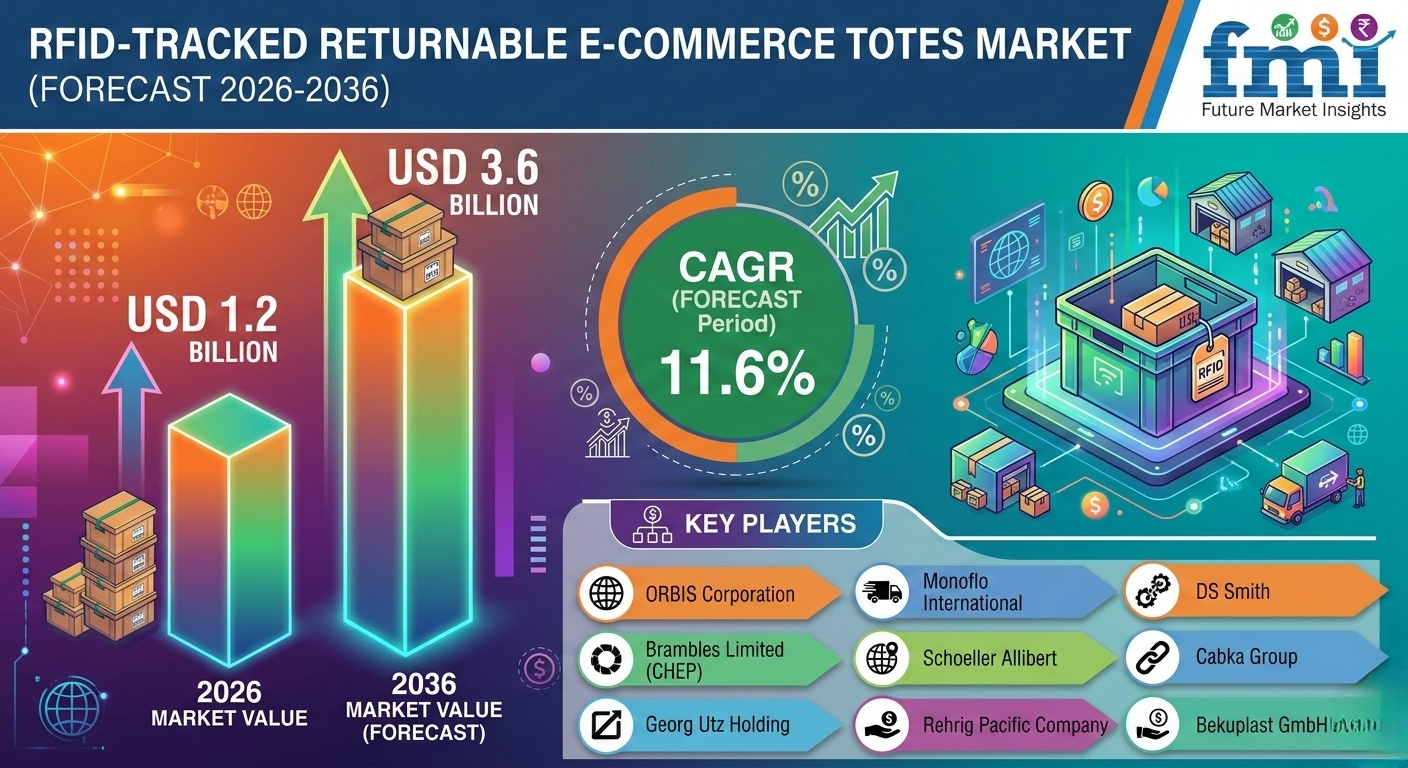
NEWARK, DE, UNITED STATES, March 17, 2026 /EINPresswire.com/ -- The global RFID-tracked returnable e-commerce totes market is entering a period of accelerated adoption as retailers and third-party logistics providers modernize reverse-logistics infrastructure. According to analysis by Future Market Insights (FMI), the market was valued at USD 1.1 billion in 2025 and is projected to reach USD 1.2 billion in 2026, expanding at a CAGR of 11.6%. Continued investment in automated fulfillment and circular packaging systems is expected to drive the market to USD 3.6 billion by 2036.
The shift reflects structural changes in global e-commerce supply chains. Retailers are deploying RFID-enabled reusable polymer totes to replace single-use corrugated packaging in high-velocity fulfillment environments. These containers allow logistics systems to automatically track shipments and reconcile returned inventory in real time, helping companies reduce operational costs, minimize packaging waste, and accelerate the resale cycle of returned goods.
Market Snapshot (2026–2036)
• Market size (2026): USD 1.2 billion
• Projected market value (2036): USD 3.6 billion
• Forecast CAGR (2026–2036): 11.6%
• Leading material segment: High-Density Polyethylene (58.0% share in 2026)
• Dominant end-use sector: Fashion and apparel (42.0% share in 2026)
• Leading technology: UHF Passive RFID (64.0% share in 2026)
Uncover the Massive Potential of the Market – Get Our Sample Report Now
https://www.futuremarketinsights.com/reports/sample/rep-gb-32268
Growing Pressure to Replace Disposable Packaging
Institutional pressure to reduce packaging waste is fundamentally altering how fulfillment centers manage outbound shipping assets. Regulatory initiatives, particularly in Europe, are pushing e-commerce companies to adopt reusable transport packaging to meet sustainability targets.
The EU Packaging and Packaging Waste Regulation (2024/2841) requires retailers to transition toward reusable shipping formats as part of broader environmental compliance goals set for 2030. At the same time, rising prices for corrugated fiberboard are prompting logistics operators to seek long-term alternatives with lower cost-per-cycle.
Reusable plastic totes equipped with RFID technology can typically withstand 20 or more circulation cycles, enabling a lower overall cost compared with disposable boxes while delivering additional data visibility across the supply chain.
Industry analysts note that the real value of these assets lies not only in their durability but also in the data captured by RFID tags, which allows inventory to be reconciled immediately when items return to the distribution network.
RFID Tracking Enables Real-Time Inventory Visibility
RFID-tracked returnable e-commerce totes are rugged polymer containers embedded with radio-frequency identification tags, typically operating on UHF bands. The technology enables automated identification of totes and their contents as they move through sorting systems, delivery vehicles, and warehouse gates.
Unlike barcode-based systems that require line-of-sight scanning, RFID readers can detect multiple assets simultaneously, allowing automated systems to process large volumes of packages without manual intervention.
According to FMI analysis, the adoption of UHF passive RFID technology will account for approximately 64.0% of the market in 2026, reflecting its ability to scan hundreds of nested containers in bulk and improve inbound receiving speeds by as much as 80%.
This technological shift supports the increasing demand for real-time inventory reconciliation, particularly in sectors with high return rates such as fashion and apparel.
Fashion E-Commerce Drives Early Adoption
The fashion and apparel segment is expected to represent 42.0% of the market in 2026, making it the largest application category for RFID-tracked totes.
High return rates in apparel e-commerce require retailers to process returned items quickly in order to restore inventory availability. RFID-enabled containers allow returned garments to be automatically identified and re-entered into sellable inventory within minutes of arrival at sorting facilities.
FMI analysts indicate that the combination of RFID tracking with advanced warehouse automation systems—including robotic garment-handling equipment—helps retailers reduce stock delays and improve SKU-level accuracy across large fulfillment networks.
High-Density Polyethylene Emerges as Dominant Material
Material selection remains critical for returnable logistics packaging operating in automated distribution environments.
According to the FMI report, High-Density Polyethylene (HDPE) totes account for 58.0% of the market share in 2026, largely due to their impact resistance and compatibility with high-speed conveyor systems.
HDPE containers are widely adopted because they:
• Withstand mechanical stress from automated sortation systems and vertical lifts
• Maintain structural stability during high-temperature sanitization cycles required for grocery logistics
• Support recycling programs through mono-material designs that simplify end-of-life processing
These characteristics make HDPE a preferred material for organizations deploying reusable packaging fleets across automated warehouse networks.
Regional Growth Reflects E-Commerce Infrastructure Expansion
Adoption of RFID-tracked returnable totes varies significantly across global logistics markets, influenced by automation levels, regulatory frameworks, and infrastructure development.
China is projected to lead global growth with a 14.5% CAGR through 2036, driven by the State Post Bureau’s “Green Express” initiative promoting returnable packaging across major logistics hubs.
India is expected to expand at 13.8% CAGR, supported by rapid investment in organized retail distribution centers and the expansion of e-commerce logistics into Tier-2 cities.
Other major markets include:
• United States: 10.2% CAGR as retailers seek to mitigate the operational cost of apparel returns
• Germany: 9.5% CAGR driven by strict extended producer responsibility (EPR) regulations
• United Kingdom: 8.4% CAGR supported by environmental compliance initiatives
• Japan: 7.9% CAGR linked to advanced robotics integration in urban fulfillment centers
• South Korea: 7.2% CAGR as high-density logistics automation expands
The Asia-Pacific region overall is emerging as a key growth hub due to large-scale investments in automated logistics infrastructure and greenfield distribution facilities.
Competitive Landscape
The market includes a mix of packaging manufacturers and logistics equipment providers developing reusable RFID-enabled transport systems. Key companies profiled in the FMI report include:
• ORBIS Corporation
• Brambles Limited (CHEP)
• Georg Utz Holding
• Monoflo International
• Schoeller Allibert
• Rehrig Pacific Company
• Myers Industries
• DS Smith
• Cabka Group
• Bekuplast GmbH
Industry participants are increasingly aligning product portfolios with interoperable RFID standards to support multi-vendor logistics ecosystems and meet the operational requirements of large third-party logistics networks.
Research Methodology
The findings are based on a combination of primary interviews and secondary research conducted across more than 40 countries. Analysts engaged with reverse-logistics directors, e-commerce procurement leads, and RFID hardware engineers to evaluate adoption timelines and cost-per-cycle thresholds for reusable packaging fleets.
Why FMI: https://www.futuremarketinsights.com/why-fmi
Explore More Research Reports by FMI
Travel-Ready Sanitizer and Disinfectant Packaging Market - https://www.futuremarketinsights.com/reports/travel-ready-sanitizer-and-disinfectant-packaging-market
Cosmetic Glass Ampoule Market - https://www.futuremarketinsights.com/reports/cosmetic-glass-ampoule-market
Peggable Packaging for IT Accessories Market - https://www.futuremarketinsights.com/reports/peggable-packaging-for-it-accessories-market
Transit Packaging Solutions for IT Hardware Accessories Market - https://www.futuremarketinsights.com/reports/transit-packaging-solutions-for-it-hardware-accessories-market
Elastic Palletizing Bands Market - https://www.futuremarketinsights.com/reports/elastic-palletizing-bands-market
About Future Market Insights (FMI)
Future Market Insights, Inc. (FMI) is an ESOMAR-certified, ISO 9001:2015 market research and consulting organization, trusted by Fortune 500 clients and global enterprises. With operations in the U.S., UK, India, and Dubai, FMI provides data-backed insights and strategic intelligence across 30+ industries and 1200 markets worldwide.
Sudip Saha
Future Market Insights Inc.
+1 347-918-3531
email us here
Legal Disclaimer:
EIN Presswire provides this news content "as is" without warranty of any kind. We do not accept any responsibility or liability for the accuracy, content, images, videos, licenses, completeness, legality, or reliability of the information contained in this article. If you have any complaints or copyright issues related to this article, kindly contact the author above.
