

Liver Cancer Diagnostics Market Valued at USD 9.58 Billion in 2024, Set to Reach USD 17.82 Billion by 2034 at 6.40% CAGR
Liver Cancer Diagnostics Market

Liver Cancer Diagnostics Market size
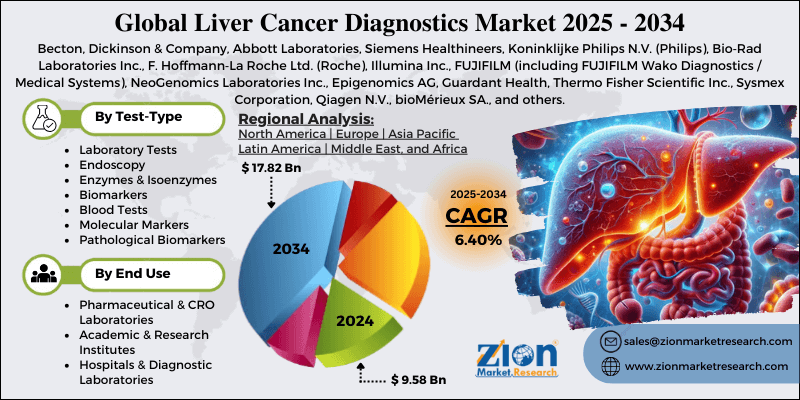
The global liver cancer diagnostics market size was worth around USD 9.58 billion in 2024 and is predicted to grow to around USD 17.82 billion by 2034
Click to Request a Sample of this Report for Additional Market Insights:-https://www.zionmarketresearch.com/sample/liver-cancer-diagnostics-market
The growth outlook of the market reflects increasing adoption of molecular diagnostics, imaging technologies, non-invasive testing solutions, and advanced screening programs. Demand is being strengthened by the growing burden of hepatitis-related liver disorders, alcohol-associated liver disease, and lifestyle-driven risk factors. Early detection remains a critical medical priority, and diagnostics are playing a central role in improving survival outcomes, enabling faster treatment decisions, and supporting personalized medicine approaches in oncology.
Market Overview
Liver cancer diagnostics involve a wide spectrum of medical tests, laboratory procedures, and imaging technologies used to identify liver tumors at early, intermediate, or advanced stages. These diagnostics help in detecting hepatocellular carcinoma (HCC), cholangiocarcinoma, and metastatic liver tumors, which account for a major share of liver-related cancer cases.
The most commonly used diagnostic methods include:
Blood-based biomarker tests
Alpha-fetoprotein (AFP) tests
Liver function tests
Ultrasound and Doppler scans
CT and MRI imaging
PET-CT scans
Histopathology and biopsy
Molecular and genetic testing
Liquid biopsy and circulating tumor DNA (ctDNA) analysis
The clinical value of liver cancer diagnostics lies in early disease detection, risk identification, treatment planning, staging, and ongoing monitoring of therapy response. With liver cancer ranking among the leading causes of global cancer deaths, diagnostic accuracy and rapid screening capabilities have become essential priorities for healthcare providers and policymakers.
Market Growth Dynamics
Rising Prevalence of Liver Cancer
The increasing global incidence of liver cancer remains the strongest driver of market expansion. Factors contributing to rising liver tumor cases include:
Chronic hepatitis B and C infections
Alcohol-associated liver cirrhosis
Non-alcoholic fatty liver disease (NAFLD)
Diabetes and obesity-related metabolic disorders
Exposure to liver-damaging toxins
As liver cancer is often diagnosed at an advanced stage due to late symptom onset, the need for early detection and screening programs continues to intensify. This has significantly increased the demand for laboratory and imaging-based diagnostic services.
Technological Advancements in Diagnostic Tools
Cutting-edge innovations are transforming diagnostic accuracy, speed, and precision. Key advancements shaping the market include:
High-resolution imaging technologies
Artificial intelligence-assisted imaging interpretation
Automated laboratory analyzers
Molecular biomarker testing
Genomic and proteomic profiling
Liquid biopsy technologies
These innovations enable:
Early tumor identification
Reduction in false-positive results
Real-time monitoring of disease progression
Personalized therapy selection
Healthcare providers are increasingly adopting integrated diagnostic platforms to improve patient outcomes, leading to stronger demand across hospitals and diagnostic laboratories.
Growing Shift Toward Non-Invasive Diagnostics
Non-invasive liver cancer diagnostics are gaining rapid acceptance due to their convenience and patient safety benefits. Techniques such as liquid biopsy, blood biomarker screening, and advanced imaging methods are emerging as preferred first-line diagnostic tools in many clinical settings.
These approaches reduce the need for invasive biopsies, minimize patient discomfort, and allow for repeated testing for treatment monitoring. As healthcare systems increasingly emphasize preventive screening, the adoption of non-invasive diagnostic solutions is expected to rise significantly over the forecast period.
Increasing Awareness and Screening Programs
Public health agencies, cancer foundations, and healthcare organizations worldwide are strengthening liver cancer awareness initiatives, especially for high-risk populations such as chronic hepatitis patients and individuals with liver cirrhosis. Early screening programs are being integrated into national healthcare policies in several countries, particularly across Asia-Pacific and developed Western economies.
Improved access to diagnostics, enhanced patient education, and expanded insurance support are contributing to sustained market demand.
Do You Have Any Query Or Specific Requirement? Request Customization of Report:-https://www.zionmarketresearch.com/custom/9915
Market Segmentation Analysis
By Test Type
1. Laboratory Tests
Laboratory-based diagnostic testing accounts for a significant share of the global market. These tests include:
Alpha-fetoprotein (AFP) tests
Serum biomarker testing
Liver function profiling
Laboratory diagnostics are preferred due to:
Affordability
Ease of use
Widespread availability
They are widely integrated into routine screening programs, making them an essential component of liver cancer detection pathways.
2. Imaging Diagnostics
Imaging technologies represent another major market segment and play a vital role in tumor identification, staging, and surgical planning. Key imaging modalities include:
Ultrasound
CT scans
MRI scans
PET & PET-CT imaging
Advancements in image resolution, AI-driven analysis software, and digital radiology systems have significantly improved diagnostic precision.
3. Biopsy & Histopathology
Biopsy remains the gold standard for confirming liver cancer diagnosis in complex or uncertain cases. Histopathology testing allows clinicians to examine tissue samples at the cellular level, enabling accurate classification of tumor types and aggressiveness.
Although invasive, biopsy continues to remain relevant, particularly when imaging results are inconclusive.
4. Molecular & Advanced Diagnostics
Molecular diagnostics represent one of the fastest-growing market segments, driven by the rise of precision oncology and personalized medicine.
Key technologies include:
Liquid biopsy
Circulating tumor DNA testing
Multi-omics profiling
Genetic mutation analysis
These advanced diagnostic tools provide deep biological insight into tumor behavior and support targeted therapy decision-making.
By End-Use
1. Hospitals & Diagnostic Centers
Hospitals remain the primary end-users of liver cancer diagnostic solutions due to:
High patient admission rates
Availability of integrated laboratory and imaging services
Strong oncology department infrastructure
Specialized cancer centers and multi-specialty hospitals form the backbone of diagnostic demand across both developed and developing countries.
2. Research & Academic Institutes
Academic and clinical research institutions play a major role in developing new diagnostic biomarkers, validating emerging diagnostic technologies, and supporting clinical trials.
They contribute significantly to innovation and future diagnostic advancements.
3. Contract Research & Diagnostic Organizations
Pharmaceutical companies and CROs utilize liver cancer diagnostics to support:
Drug development programs
Companion diagnostic testing
Clinical research initiatives
This segment is expected to expand steadily over the coming years.
Regional Market Insights
North America
North America holds a strong share of the global market due to:
Advanced healthcare infrastructure
High awareness of cancer screening
Strong diagnostic technology adoption
Significant research investments
The region continues to drive innovation in AI-based diagnostics, liquid biopsy platforms, and molecular cancer screening technologies.
Europe
Europe demonstrates steady and stable market growth supported by:
Well-structured healthcare systems
Widespread cancer prevention policies
Government-funded screening programs
Strong presence of medical device manufacturers
Western European nations lead regional market expansion, while Eastern Europe shows increasing adoption trends.
Asia-Pacific
Asia-Pacific is emerging as one of the fastest-growing regional markets due to:
High liver cancer prevalence
Growing urban healthcare infrastructure
Increasing awareness of early detection
Expanding diagnostic laboratory networks
Countries such as China, Japan, South Korea, and India present significant growth opportunities due to large patient populations and rising healthcare investment.
Latin America, Middle East & Africa
These regions are witnessing gradual market expansion supported by:
Improvements in hospital infrastructure
Growing investments in diagnostic services
Expanding access to oncology treatment facilities
Urban centers remain the primary hubs for diagnostic services, with increasing government focus on improving cancer care accessibility.
Inquiry For Buying-https://www.zionmarketresearch.com/inquiry/liver-cancer-diagnostics-market
Competitive Landscape
The global liver cancer diagnostics market is led by players like:
Becton
Dickinson & Company
Abbott Laboratories
Siemens Healthineers
Koninklijke Philips N.V. (Philips)
Bio‑Rad Laboratories Inc.
F. Hoffmann‑La Roche Ltd. (Roche)
Illumina Inc.
FUJIFILM (including FUJIFILM Wako Diagnostics / Medical Systems)
NeoGenomics Laboratories Inc.
Epigenomics AG
Guardant Health
Thermo Fisher Scientific Inc.
Sysmex Corporation
Qiagen N.V.
bioMérieux SA.
The global liver cancer diagnostics market is characterized by the presence of:
Established medical technology companies
Diagnostic equipment manufacturers
Biotechnology firms
Emerging startups specializing in molecular diagnostics
Key areas of strategic focus among industry players include:
Product innovation
Expansion of diagnostic portfolios
Research collaborations
Entry into emerging healthcare markets
Integration of AI and digital solutions
Partnerships with hospitals, research labs, and screening program providers are also becoming increasingly common.
Key Market Trends
Several important trends are shaping the future of the liver cancer diagnostics industry:
Adoption of AI in Diagnostic Imaging
Artificial intelligence and machine learning technologies are being integrated into imaging platforms to:
Improve interpretation accuracy
Reduce diagnostic time
Detect early-stage abnormalities
This trend is expected to gain further momentum during the forecast period.
Growth of Precision & Personalized Diagnostics
The shift toward personalized cancer treatment is increasing demand for:
Molecular biomarker testing
Genomic sequencing
Companion diagnostics
These advanced diagnostics provide deeper clinical insights and support targeted therapy selection.
Expansion of Point-of-Care & Mobile Diagnostics
Portable imaging devices and mobile laboratory diagnostics are improving accessibility in rural and remote regions, especially in developing economies. These solutions enhance early detection capabilities and help bridge the healthcare accessibility gap.
Market Challenges
Despite strong growth prospects, the industry faces certain challenges:
High costs of advanced diagnostics
Reimbursement limitations in some regions
Shortage of trained diagnostic specialists
Uneven access to healthcare infrastructure
Limited availability of advanced technologies in developing regions
Addressing these barriers remains critical for expanding diagnostic coverage globally.
Future Outlook (2025–2034)
The global liver cancer diagnostics market is expected to continue expanding steadily over the next decade. Key growth opportunities include:
Wider adoption of non-invasive diagnostic technologies
Integration of AI and smart diagnostic software
Increasing government screening initiatives
Expansion of healthcare services in emerging economies
Stronger investments in oncology research
Continued innovation, cross-industry collaboration, and technology democratization will play essential roles in improving patient outcomes and supporting early detection worldwide.
Conclusion
The global liver cancer diagnostics market is positioned for sustained long-term growth, driven by rising disease prevalence, rapid technological advancements, and increasing emphasis on early detection and screening initiatives. With the market expected to rise from USD 9.58 billion in 2024 to approximately USD 17.82 billion by 2034 at a CAGR of about 6.40%, the sector presents significant opportunities for diagnostic companies, healthcare providers, investors, and research organizations.
Strengthening diagnostic accessibility, improving affordability, and expanding the use of advanced molecular and imaging technologies will remain central to market development — and most importantly, to improving survival outcomes and quality of life for patients affected by liver cancer across the globe.
Browse Other Related Research Reports from Zion Market Research-
Male Hypogonadism Market- by Therapy (Testosterone replacement therapy, Gonadotropin-releasing hormones therapy), by Drug delivery (Injectables, Topical gels, Transdermal patches, Others), by Type (Kallmann syndrome, Klinefelters syndrome, Pituitary disorders, Others) - Global Industry Perspective Comprehensive Analysis and Forecast, 2024 - 2032-https://www.zionmarketresearch.com/report/male-hypogonadism-market
qPCR Reagents Market: By End-User (Pharmaceutical & Biotechnology Companies, Hospitals & Diagnostic Centers, Forensic Laboratories, Research Laboratories & Academic Institutes, and Clinical Research Organizations), By Packing Method (qPCR Mastermixes and qPCR Core Kits), By Application (Research, Forensic, and Diagnostic), and By Detection (Probe & Primer-Based Reagents and Dye-Based Reagents), and By Region: Global Industry Perspective, Comprehensive Analysis and Forecast, 2024 - 2032-https://www.zionmarketresearch.com/report/qpcrreagents-market
Viral Disease Diagnosis Market- by End users (Hospitals, Physician clinics, Nursing homes, Commercial laboratories), by Diagnostic test (Serodiagnostic tests, Specimen examination, Viral isolation), by Virus type (Dengue virus, Hepatitis virus, HIV-1, Human Metapneumovirus, Measles Virus, Rabies virus, Avian Influenza, Enterovirus, Coronavirus, Poliovirus, Others) - Global Industry Perspective Comprehensive Analysis and Forecast, 2024 - 2032-https://www.zionmarketresearch.com/report/viral-disease-diagnosis-market
Stem Cells Market, By Product Type (Pluripotent Cells, Human Embryonic Stem Cells, Adult Stem Cells, and Others), By Source (Allogeneic, and Autologous), By Application (Development & Drug Discovery, and Regenerative Medicine), and By End User (Tissue & Cell Banks, Therapeutic Companies, Service Companies, and Reagent & Tools Companies): Global Industry Perspective, Comprehensive Analysis and Forecast, 2024 - 2032-https://www.zionmarketresearch.com/report/stem-cells-market
Protein Shampoo Market: by Distribution Channel (Supermarkets & Hypermarkets and Ecommerce Portals): Global Industry Perspective, Comprehensive Analysis and Forecast, 2024 - 2032-https://www.zionmarketresearch.com/report/protein-shampoo-market
Organic Soaps Market: By Product (Bar, and Liquid), by Distribution Channel (Online, and Offline), and By Region: Global Industry Perspective, Comprehensive Analysis, and Forecast, 2024 - 2032-https://www.zionmarketresearch.com/report/organic-soaps-market
Organic Deodorants Market: by Type (Roll-Ons, Sticks/Creams, and Sprays), and by Distribution Channel (Supermarkets/Hypermarkets, Convenience Stores, and Online): Global Industry Perspective, Comprehensive Analysis, and Forecast, 2024 - 2032-https://www.zionmarketresearch.com/report/organic-deodorants-market
Almond Oil Market: by Product (Sweet and Bitter), and Application (Personal Care & Cosmetics, Pharmaceuticals, Food): Global Industry Perspective, Comprehensive Analysis and Forecast, 2024 - 2032-https://www.zionmarketresearch.com/report/almond-oil-market
Large Scale Hot Foil Stamper and Fuser Market by Type (Hot Foil Stamper, and Hot Foil Fuser), and By Application (Personal Care and Cosmetics Packaging, Electronics and Industrial Parts Packaging, Food & Beverages Packaging, Paper and Boards Packaging, Others): Europe Industry Perspective, Comprehensive Analysis, and Forecast, 2024 - 2032-https://www.zionmarketresearch.com/report/large-scale-hot-foil-stamper-and-fuser-market
Deepak Rupnar
Zion Market Research
+1 855-465-4651
richard@zionmarketresearch.com
Visit us on social media:
LinkedIn
Instagram
Facebook
YouTube
X
Legal Disclaimer:
EIN Presswire provides this news content "as is" without warranty of any kind. We do not accept any responsibility or liability for the accuracy, content, images, videos, licenses, completeness, legality, or reliability of the information contained in this article. If you have any complaints or copyright issues related to this article, kindly contact the author above.
